How to choose headphones for yoga
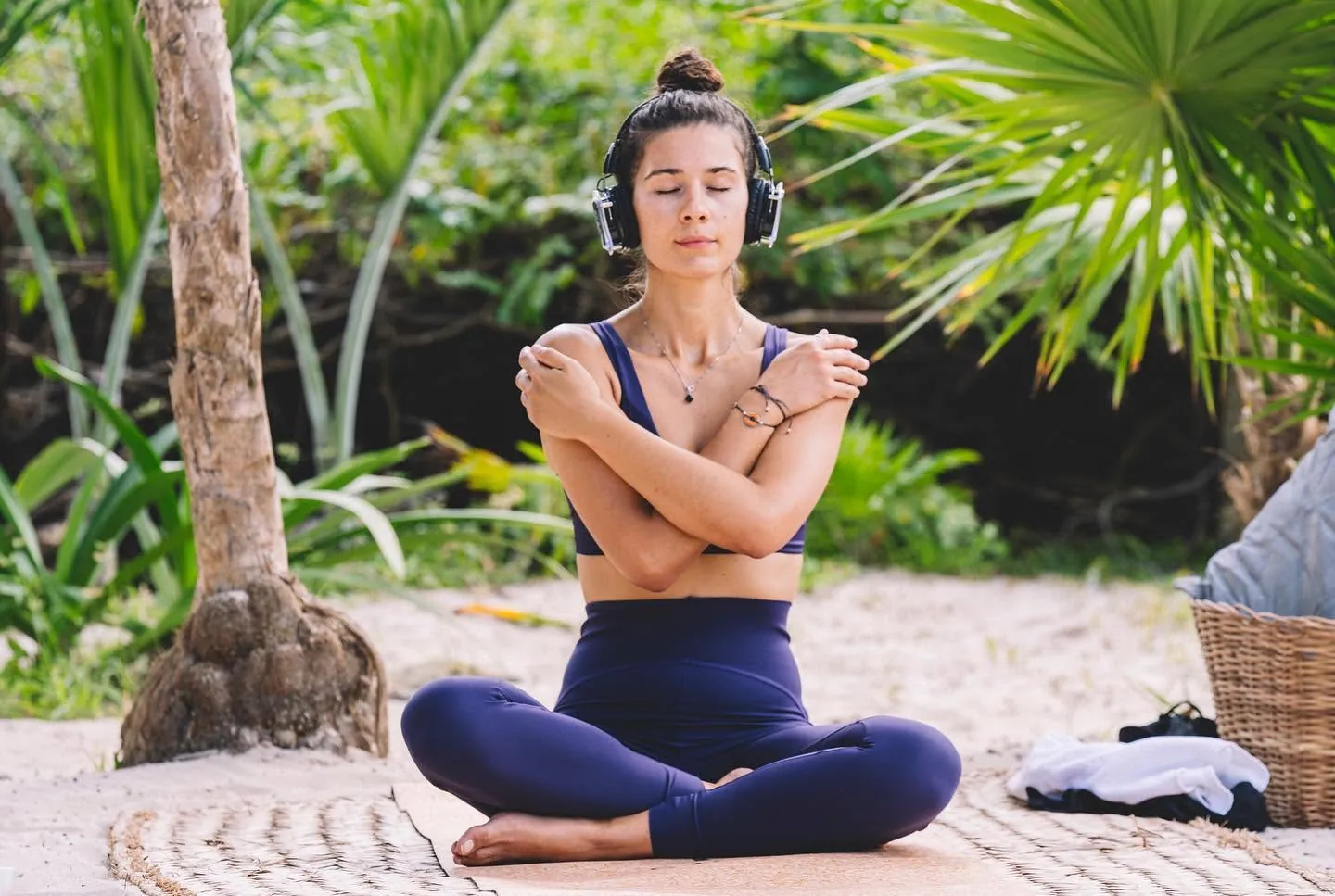
Not every wireless headphone works for a class. These are the criteria that really matter when twenty people lying on mats are wearing them.
Radio frequency, not Bluetooth
Bluetooth connects one phone to one headphone. A class needs the opposite: one transmitter speaking to all headphones at once, with no pairing and no app. Radio-frequency systems work on dedicated bands and do not depend on Wi-Fi.
Comfort and support
In floor postures the head rests on the mat: soft cups avoid pressure points. For long lying-down practices such as yoga nidra, comfort matters more than anything else.
Lights that switch off
LEDs help people find their way between channels and bring the party to a yoga party, but during the final relaxation a glowing light is distracting. Choose models whose lights can be switched off.
Simple controls
People practising with eyes closed must find the volume by touch. The fewer buttons, the better: one for the channel and one control for the volume.
Battery life
A class needs a few hours, but a festival or a day of workshops needs a battery that lasts until evening. The headphones we use last up to 10–14 hours, depending on model and volume.
How many channels
For yoga three channels are enough: one for the class, the others for a second class, a variation, a translation or a DJ. More channels make things more complicated without real benefits for a group that is practising.
The two headphones we recommend, with their specs, are on yoga headphones.
The five criteria
One source for every headphone, no app.
For floor postures and lying-down practices.
For the final relaxation in the dark.
Volume easy to find with eyes closed.
Enough for parallel classes, variations or a DJ.
Take your practice into headphones
Tell us where you practise, when and with how many people: you get a tailored proposal within one working day.